Quick answer
Cattle gestation averages 283 days, but it ranges from about 279 days in Holsteins and Jerseys to 292 days in Brahman cattle. A cattle gestation calculator adds your breed’s average to the breeding date.
Example, bred April 1: Holstein calves around Jan 5, Angus Jan 6, Hereford Jan 11, Charolais Jan 15, Brahman Jan 18.
How to use the cattle gestation calculator
Most cattle pregnancy calculators add 283 days and stop. That can be a week or more out for many breeds, so this one starts with the breed:
- Choose the breed. The list is grouped into British beef, Continental beef, tropical (Bos indicus) and dairy breeds. For a crossbred cow, pick the breed of the sire or use the average.
- Choose how she was bred. Breeding date for AI or a single observed mating; Bull in & out for natural service, which gives the whole calving spread for the group.
- Add the sire’s gestation length EPD if you have it under More options. It shifts the date by the bull’s genetic difference.
The result shows the due date, the normal window and how the gestation length was worked out, so you can see what the breed and the bull each add.
Cattle gestation length: how long are cattle pregnant?
The textbook cattle gestation period is 283 days (about 9 months and 10 days), and most published ranges run from 279 to 287 days. Individual pregnancies are more spread out: in a Kansas State University study of more than 100,000 Angus AI matings, gestation ranged from 264 to 292 days.
That same study found an average of 278.6 days, and a separate analysis of about 10,000 beef records found 280.2 days. Modern beef cattle are carrying calves a few days less than the 283-day rule suggests. Gestation shortened by about 4 days over 20 years as breeders selected for lighter birth weights and easier calving.
What this means for you: the 283-day figure is a safe planning number, but your breed’s average (and your own herd records) give a closer date. If you know your herd runs short or long, type your own number under More options → my own gestation.
Cattle gestation by breed
Here’s how the common breeds line up, shortest to longest:
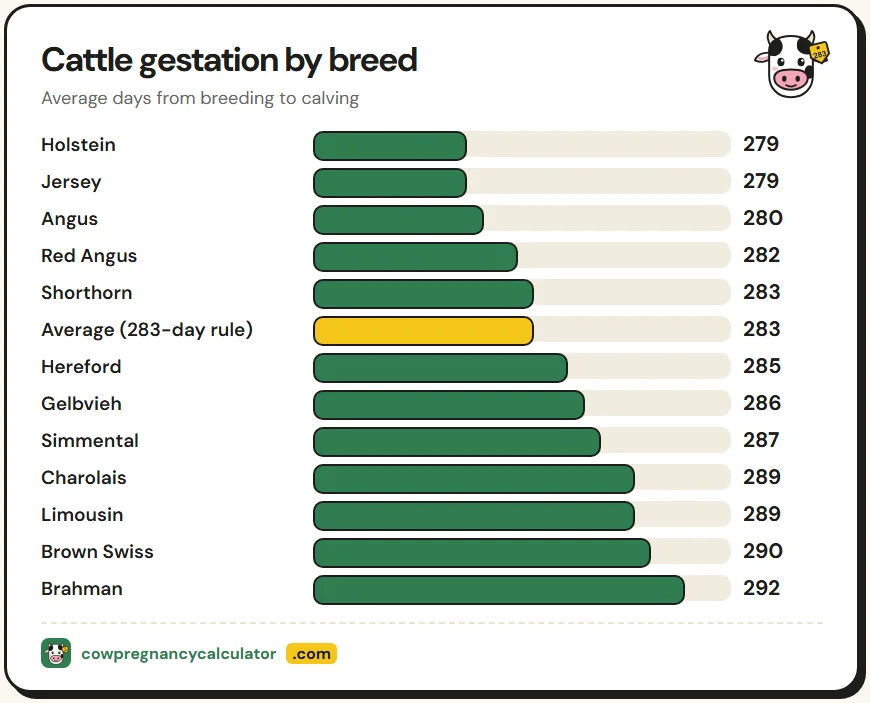
And the full list, with the normal range and the difference from the 283-day standard:
| Breed | Average gestation | Normal range (days) | vs. 283 days | Bred Apr 1 → calves |
|---|---|---|---|---|
| All cattle (traditional average) | 283 days | 273–293 | 0 | Jan 9 |
| British beef breeds | ||||
| Angus / Black Angus | 280 days | 270–290 | -3 | Jan 6 |
| Red Angus | 282 days | 272–292 | -1 | Jan 8 |
| Hereford | 285 days | 275–295 | +2 | Jan 11 |
| Shorthorn | 283 days | 273–293 | 0 | Jan 9 |
| Highland | 285 days | 275–295 | +2 | Jan 11 |
| Galloway / Belted Galloway | 283 days | 273–293 | 0 | Jan 9 |
| Continental beef breeds | ||||
| Simmental | 287 days | 277–297 | +4 | Jan 13 |
| Charolais | 289 days | 279–299 | +6 | Jan 15 |
| Limousin | 289 days | 279–299 | +6 | Jan 15 |
| Gelbvieh | 286 days | 276–296 | +3 | Jan 12 |
| Maine-Anjou | 286 days | 276–296 | +3 | Jan 12 |
| Tropical / Bos indicus | ||||
| Brahman | 292 days | 282–302 | +9 | Jan 18 |
| Santa Gertrudis | 285 days | 275–295 | +2 | Jan 11 |
| Droughtmaster | 288 days | 278–298 | +5 | Jan 14 |
| Other Bos indicus cross (Brangus, Beefmaster) | 286 days | 276–296 | +3 | Jan 12 |
| Dairy breeds | ||||
| Holstein / Friesian | 279 days | 269–289 | -4 | Jan 5 |
| Jersey | 279 days | 269–289 | -4 | Jan 5 |
| Guernsey | 283 days | 273–293 | 0 | Jan 9 |
| Ayrshire | 279 days | 269–289 | -4 | Jan 5 |
| Brown Swiss | 290 days | 280–300 | +7 | Jan 16 |
| Milking Shorthorn | 282 days | 272–292 | -1 | Jan 8 |
| Other bovine species | ||||
| American bison | 279 days | 269–289 | -4 | Jan 5 |
| Yak | 262 days | 252–272 | -21 | Dec 19 |
| River buffalo (water buffalo, e.g. Murrah) | 310 days | 300–320 | +27 | Feb 5 |
| Swamp buffalo (water buffalo) | 330 days | 320–340 | +47 | Feb 25 |
Breed averages come from breed associations, extension services and research herds, and individual herds vary by a few days. Crossbred cattle usually fall between their parent breeds.
Bos taurus vs. Bos indicus cattle
Cattle come from two main lines. European cattle (Bos taurus: Angus, Hereford, Simmental, Holstein, Jersey and the rest) have the shorter pregnancies. The humped tropical cattle (Bos indicus: Brahman, Nelore, Gir) carry longer.
Brahman sit at the top of the list at around 291 to 292 days. The Australian composites built partly on Brahman blood land in between: Droughtmaster at about 288 days and Santa Gertrudis at about 285. Brangus and Beefmaster usually fall somewhere around 285 to 287, depending on how much indicus is in them.
Calf sex matters more in these breeds too. Work from northern Australia found bull calves were carried two to three days longer than heifer calves in Brahman, Santa Gertrudis and Droughtmaster herds.
The bull matters: gestation length is inherited
Gestation length is one of the most heritable traits in cattle. Estimates run from about 0.3 to 0.8, which is high. In practice it means a bull passes a lot of his “short” or “long” gestation on to his calves, and his calves tend to show up at the same point in the season year after year.
Some breed associations publish a gestation length EPD (or EBV) for each bull. A value of −4 means his calves are expected about four days earlier than average. It isn’t a one-for-one shift, though: Australian Breedplan data found each day of a sire’s gestation length EBV moved the actual gestation by roughly half a day.
Is shorter better? Mostly. Short-gestation calves tend to be lighter at birth and easier to calve, and the cow gets a few extra days to recover before she’s bred again. Push it too far and you get small, weak calves, so it’s a trait to nudge rather than chase.
Using AI with a known bull? Look up his gestation length EPD in the sire directory and type it under More options. Your due date then reflects that bull, not the breed average.
Other factors in cattle gestation
| Factor | Effect on gestation |
|---|---|
| Calf sex | Bull calves about 1–3 days longer than heifer calves |
| Twins | Usually 1–2 weeks shorter |
| Age of the dam | Heifers slightly shorter; older cows slightly longer |
| Season and heat stress | Hot weather late in pregnancy can shorten gestation by a few days |
| Nutrition and health | Very thin cows, illness and some infections can cause early calving |
Using a cattle pregnancy calculator with AI and synchronization
With a timed-AI or synchronization program, a whole group of cows is bred on the same day, so they are due on the same day too. Enter the AI date once, save each cow to the herd list with her tag, and you have the due dates for the group. Cows that return to heat and are re-bred, or are covered by a clean-up bull, get their own later date.
For natural service, use Bull in & out. Cows bred in the bull’s first three weeks calve first; the last calves arrive about one gestation length after he came out. The calving calculator breaks that season into 21-day periods.
From a preg check to a due date
If a vet palpates or scans a cow and estimates her as, say, 120 days bred, choose Calving date in the cattle gestation calculator and type 120 into days pregnant. It works out the breeding date and the due date for her breed. Fetal-age estimates are usually within a week or two in mid-pregnancy, so treat the result as a window rather than an exact day.
Cattle gestation FAQ
How long are cattle pregnant?
About 283 days on average, or 9 months and 10 days. Depending on breed, the average runs from about 279 days (Holstein, Jersey) to 292 days (Brahman), and individual cows can calve 10 days either side.
How many months are cattle pregnant?
About 9.3 months. A 283-day pregnancy is 9 months and roughly 10 days. For buffalo, bison and yak, see bovine gestation.
Which cattle breed has the longest gestation?
Brahman and other Bos indicus cattle, at around 291–292 days. Among European breeds, Brown Swiss, Charolais and Limousin are the longest at about 289–290 days.
Which cattle breed has the shortest gestation?
Dairy breeds such as Holstein, Jersey and Ayrshire average about 279 days, and modern Angus herds run about 279–281 days.
Does the bull affect how long a cow is pregnant?
Yes. Gestation length is strongly inherited, so the sire’s genetics shift the due date. A bull with a negative gestation length EPD sires calves that come earlier than average.
Is cattle gestation getting shorter?
In many beef breeds, yes. Selection for lower birth weight and calving ease has shortened gestation by several days over the past few decades. Large Angus datasets now average 279–280 days instead of 283.
How accurate is a cattle pregnancy calculator?
About as accurate as the breeding date you give it. With a known AI date and the right breed, most cows calve within about 5 days of the date, and nearly all within 10 days.
Last updated October 21, 2026 · Every date on this page comes from the same data the calculators use.