Quick answer
Calving date = breeding date + 283 days. For a herd, the first calves arrive about 283 days after the bull goes in, and the last about 283 days after he comes out.
Bull in on June 1 and out on August 3 (63 days)? Calving runs from about Mar 11 to May 13.
How to use the calving calculator
The calving calculator opens in Bull in & out mode, because that is how most beef herds breed:
- Enter the day the bull went in and the day he came out (or the day you plan to pull him).
- Pick the breed. The calving calculator shows when the first calves are due, when the season should end, and the dates of each 21-day calving period.
Only after one cow’s date? Switch to Breeding date and enter her AI or mating date. You’ll get her calving date, the normal window and a countdown. To plan backwards, switch to Calving date and enter the day you want calves to start; the calving date calculator tells you when to turn the bull in.
Save each cow to the herd calving list as she is bred. On calving day you can see at a glance who is due next and who is overdue.
Planning your calving season
Most beef herds breed for a set season so calves arrive together. A short calving season gives a more even calf crop to sell, makes cows easier to feed and watch, and makes it obvious which cows are late. A practical goal is a 60-day calving season, and no more than 90 days.
- Choose your calving start date. Think about weather, grass, labour and when you sell. Spring calving often starts in February–April, fall calving in August–October.
- Subtract 283 days to get the bull turn-out or first AI date. Use Calving date mode, or the table below.
- Breed heifers 2–4 weeks before the cows. They calve earlier and get extra time to recover before the next breeding season.
- Pull the bull after about 63 days (three heat cycles) for a 60-ish-day calving season.
Bull turn-out to calving: quick table
Bull in on the 1st of the month, a 63-day breeding season and an average 283-day gestation:
| Bull in | First calves | End of period 1 (21 d) | End of period 2 (42 d) | Last calves (bull out after 63 d) |
|---|---|---|---|---|
| Jan 1 | Oct 11 | Oct 31 | Nov 21 | Dec 12 |
| Feb 1 | Nov 11 | Dec 1 | Dec 22 | Jan 12 |
| Mar 1 | Dec 9 | Dec 29 | Jan 19 | Feb 9 |
| Apr 1 | Jan 9 | Jan 29 | Feb 19 | Mar 12 |
| May 1 | Feb 8 | Feb 28 | Mar 21 | Apr 11 |
| Jun 1 | Mar 11 | Mar 31 | Apr 21 | May 12 |
| Jul 1 | Apr 10 | Apr 30 | May 21 | Jun 11 |
| Aug 1 | May 11 | May 31 | Jun 21 | Jul 12 |
| Sep 1 | Jun 11 | Jul 1 | Jul 22 | Aug 12 |
| Oct 1 | Jul 11 | Jul 31 | Aug 21 | Sep 11 |
| Nov 1 | Aug 11 | Aug 31 | Sep 21 | Oct 12 |
| Dec 1 | Sep 10 | Sep 30 | Oct 21 | Nov 11 |
Examples: for calving to start March 1, turn the bull in around May 22; for a fall herd starting September 1, around Nov 22.
21-day calving periods and calving distribution
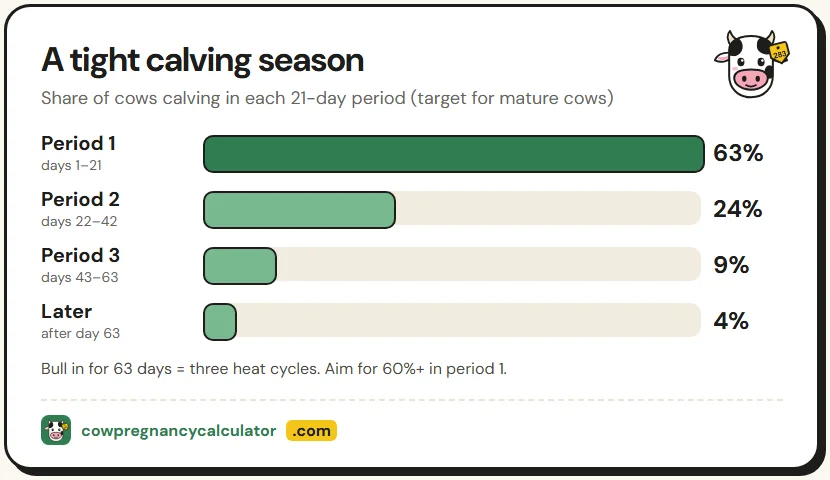
Cows cycle every 21 days, so a calving season naturally falls into 21-day periods. Cows that settle on their first heat calve in period 1, second-heat cows in period 2, and so on. The calving calculator lists these periods for your bull dates.
| Period | Days of the season | Typical target (mature cows) |
|---|---|---|
| Period 1 | Days 1–21 | 60–65% of cows calved |
| Period 2 | Days 22–42 | about 85–87% calved in total |
| Period 3 | Days 43–63 | about 95% calved in total |
| Later | After day 63 | Late calvers: watch these cows next year |
To work out your own figure, count the calves born in the first 21 days and divide by the number of cows exposed to the bull. Extension benchmarks suggest a serious look at nutrition, bull fertility and herd health if fewer than 60% calve in the first 21 days.
Why period 1 matters: calves born early in the season are older and heavier at weaning, and their mothers have more time to recover and rebreed. Moving cows from period 3 to period 1 is one of the cheapest ways to add pounds to a calf crop.
Signs a cow is about to calve
Once her calving window opens, look at her at least twice a day. The udder is usually the first giveaway: it fills, and in the last day or so the teats look tight and shiny. Around the same time the ligaments either side of the tail head relax, so the tail head seems to stick up and the hollows beside it sink in. The vulva swells and lengthens, and you may see a string of clear mucus.
Behaviour changes last. She wanders off from the herd, skips a meal, looks back at her flank, and gets up and lies down again and again with her tail held out. At that point she’s in labor.
Stages of calving and when to help
| Stage | What you see | Normal length | Get help if… |
|---|---|---|---|
| 1. Preparation | Restless, tail out, mucus; the cervix opens | 2–6 hours (longer in heifers) | No progress to stage 2 after about 6 hours |
| 2. Delivery | Water bag or feet appear; strong straining | About 30–60 minutes | No clear progress after 30 minutes in a cow or 60 minutes in a heifer, or the calf is backwards or a leg or the head is missing |
| 3. Afterbirth | Placenta passes | Usually within 8–12 hours | Not passed after 24 hours, or she seems sick |
When in doubt, call early. A calf that is stuck has minutes, not hours. Never pull unless the cervix is fully open and the calf is coming the right way; if you are not sure, call your large-animal vet straight away.
Calving kit checklist
- OB sleeves, lubricant and a bucket of warm water
- Calving chains or straps and handles; know how to use a calf puller before you need it
- Iodine for the navel, towels, and a calf feeder or tube with colostrum (frozen or replacer)
- Ear tags and a notebook to record calving date, ease and birth weight
- A flashlight and your vet’s phone number
After calving: breeding back on time
A cow’s uterus needs about 20–40 days to recover after calving, and beef cows usually don’t cycle again for 40–60 days (first-calf heifers longer). The first heat is often weak, so most herds breed back from about 50 days after calving. To calve at the same time next year, a 365-day calving interval, she must be pregnant again by about day 82 (365 − 283).
| Body condition at calving (1–9) | Average days to first heat |
|---|---|
| 3 (thin) | about 89 |
| 4 | about 70 |
| 5 (moderate) | about 59 |
| 6 (good) | about 52 |
Thin cows simply can’t make the 82-day deadline. Tap After calving: breed-back dates under any calving date in the calculator to see her breed-from date, breed-by date, next calving and 205-day weaning date.
Calving interval
Keeping a herd calving list
Think of the herd calving list as a calving book that keeps itself sorted. Add each cow with her name or tag as she’s bred. It lines them up by due date, counts down the days and highlights any cow that’s in her calving window. When the season starts you can print it for the barn, export it to a spreadsheet, or push every due date into your phone’s calendar.
Calving calculator FAQ
How do I calculate a calving date?
Add 283 days to the breeding date, or your breed’s average. A cow bred on May 10 calves around Feb 17. The calving calculator does it for you and shows the normal window around the date.
When should I put the bull in?
Count back 283 days from the day you want calving to start. For calves from March 1, turn the bull in around May 22. Put him in with the heifers 2–4 weeks earlier.
How long should a calving season be?
About 60 days is a practical goal, from a 63-day (three-cycle) breeding season. Many herds run 90 days; longer seasons make it hard to manage and market an even calf crop.
What percentage of cows should calve in the first 21 days?
Around 60–65% of mature cows, with about 85–87% calved by day 42 and 95% by day 63.
Is spring or fall calving better?
It depends on your climate, feed and markets. Spring calving matches the cow’s highest needs with spring grass; fall calving avoids winter calving weather and often suits areas with mild winters or good fall pasture. The calving calculator works for either.
How long can a cow be in labor?
Stage 1 lasts about 2–6 hours. Once the water bag or feet appear, a cow should make clear progress within 30 minutes and a heifer within an hour. If not, or if the calf is in the wrong position, she needs help.
How soon after calving can a cow be bred?
Most herds start at about 50 days after calving (later for first-calf heifers). To keep a 365-day calving interval she needs to be pregnant again by about day 82.
Last updated October 21, 2026 · Every date on this page comes from the same data the calculators use.