Quick answer
A cow is pregnant for about 283 days, which is 9 months and 10 days. Count 283 days from the breeding date and you have her due date. Most cows calve within 10 days of it, one way or the other.
Bred on January 1? She’s due around Oct 11. Bred on June 1? Around Mar 11.
How to use the cow pregnancy calculator
There are only two things to fill in. Everything else is optional.
Step 1: tell it what you know
Most people know the breeding date, so that tab is already selected. If a bull ran with the cows, pick Bull in & out instead. If all you have is a vet’s due date, or a “she’s about 90 days along” from a preg check, pick Calving date.
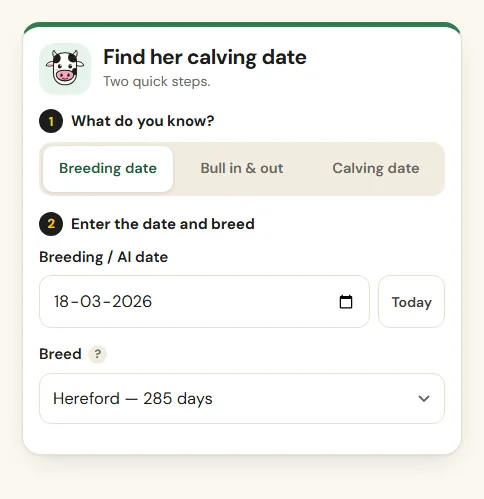
Step 2: enter the date and breed
Breed matters more than people think. A Holstein and a Brahman bred on the same morning can calve nearly two weeks apart. Leave it on Average if you’re not sure. As soon as the date is in, her calving date, the normal calving window and a countdown appear on the right.
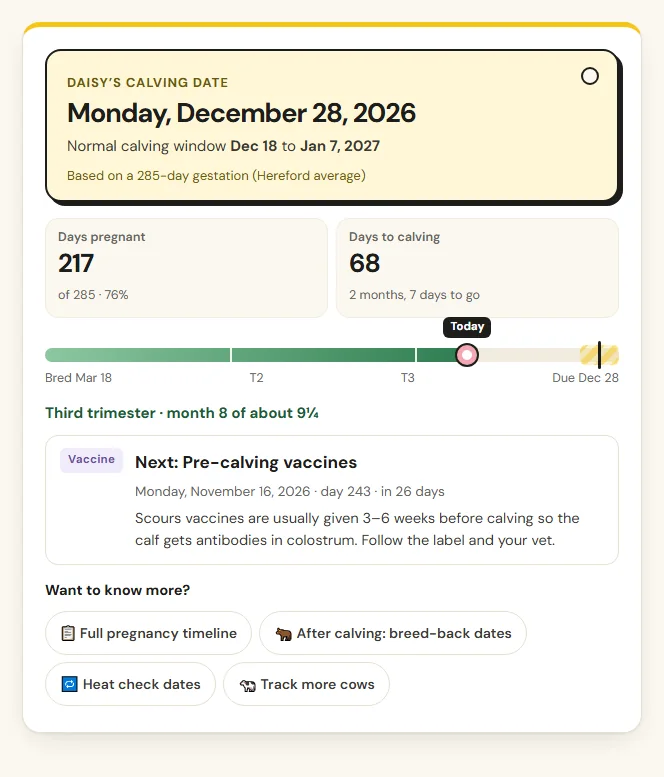
Step 3: dig deeper only if you want to
Under the result there’s a row of buttons. Full pregnancy timeline lists every job from the heat check to calving day, with real dates. After calving tells you when to breed her back. If you’re keeping track of a few cows, Track more cows opens a simple herd list you can export or print.
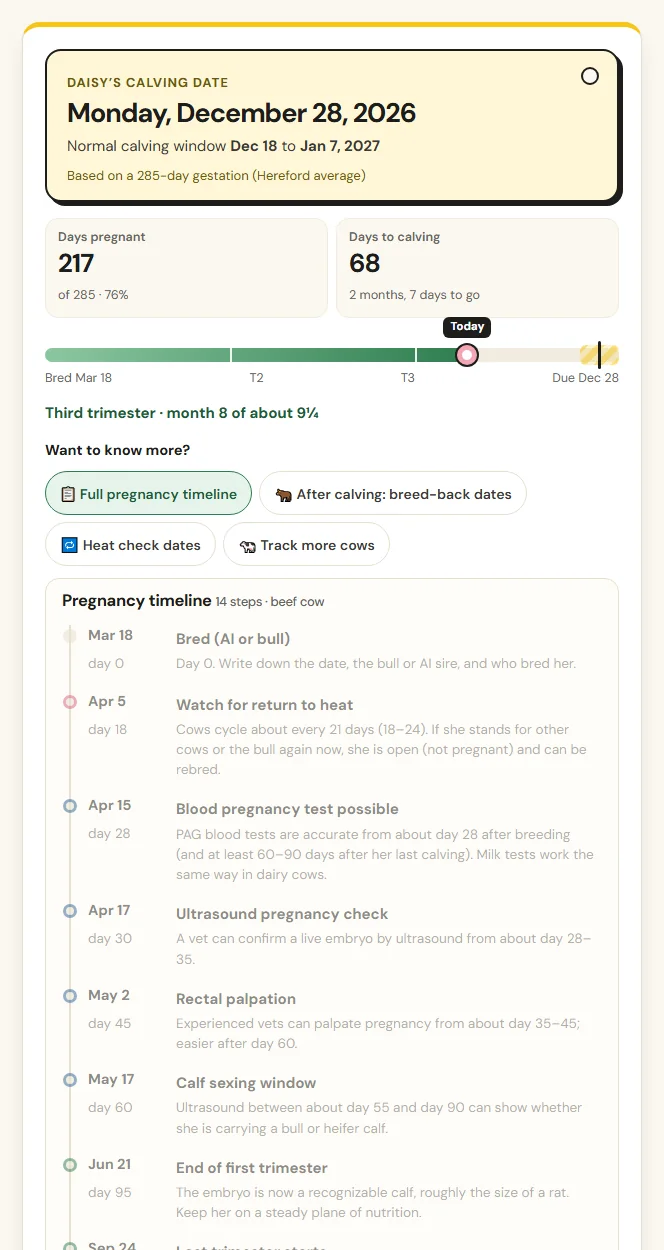
And if you know a bit more about her, open More options. You can give her a name, switch to dairy (which adds a dry-off date), or allow for a first-calf heifer, twins, the calf’s sex or the bull’s gestation EPD. The result then shows the arithmetic, something like “Hereford average 285 + bull calf +1 = 286 days”.
Type her name or tag number under More options. The result turns into “Daisy’s calving date”, which makes it a lot easier to keep five cows straight.
How long is a cow pregnant? (cow gestation period)
The cow gestation period most people quote is 283 days. Breed associations use it, most calculators use it, and it’s a fine number to plan around. The interesting part is that real cows are drifting shorter. Big studies of AI-bred beef cows now put the average closer to 279 to 281 days, mostly because breeders have spent decades picking bulls for easy calving.
Either way, a healthy cow can calve on any day from about 273 to 293. Heifers carry just as long as mature cows, maybe a day less. That spread is why the tool above shows a window and not just a single day. It’s really a cow gestation period calculator as much as a due date one.
| Cow gestation period in… | Average | Normal range |
|---|---|---|
| Days | 283 days | 273–293 days |
| Weeks | 40.4 weeks | 39–42 weeks |
| Months | 9.3 months (9 months 10 days) | 9 to 9⅔ months |
| Trimesters | 3 × about 94 days | – |
Want every breed? They’re all on the cattle gestation calculator page.
Working out a calving date by hand
The quick way is to add 9 months and 10 days. It’s close, but not exact, because months aren’t the same length. For a cow bred on March 5, the shortcut says December 15. The true 283-day date is Dec 13. A couple of days rarely matters, but it’s worth knowing.
Going the other way works too. Say the vet palpates her and calls it 90 days. That leaves about 193 days (283 − 90). Type 90 into days pregnant and the cow pregnancy calculator does the counting.
If you’d rather have it on paper, print the cattle gestation table. It lists a calving date for every day of the year.
Why some cows calve early and others late
Breed is the big one, for both the cow and the bull. Dairy breeds and British beef breeds run short; Continental and Brahman-type cattle run long. Then there are the smaller nudges:
- Bull calves usually stay in a day or three longer than heifer calves.
- Twins tend to come one to two weeks early.
- Young heifers go a little early, older cows a little late.
- A hot spell or a thin cow in late pregnancy can bring things forward.
The calculator allows for breed, the bull’s EPD, calf sex, twins and first-calf heifers. It can’t see the weather, though.
Cow pregnancy timeline, day by day
This is the list that shows up when you tap Full pregnancy timeline, here counted from the breeding day for a 283-day pregnancy.
| When | Type | What happens / what to do |
|---|---|---|
| Day 0month 1 | Bred | Bred (AI or bull) — Day 0. Write down the date, the bull or AI sire, and who bred her. |
| Day 18month 1 | Heat check | Watch for return to heat — Cows cycle about every 21 days (18–24). If she stands for other cows or the bull again now, she is open (not pregnant) and can be rebred. |
| Day 28month 1 | Pregnancy check | Blood pregnancy test possible — PAG blood tests are accurate from about day 28 after breeding (and at least 60–90 days after her last calving). Milk tests work the same way in dairy cows. |
| Day 30month 2 | Pregnancy check | Ultrasound pregnancy check — A vet can confirm a live embryo by ultrasound from about day 28–35. |
| Day 45month 2 | Pregnancy check | Rectal palpation — Experienced vets can palpate pregnancy from about day 35–45; easier after day 60. |
| Day 60month 3 | Pregnancy check | Calf sexing window — Ultrasound between about day 55 and day 90 can show whether she is carrying a bull or heifer calf. |
| Day 94month 4 | Care | End of first trimester — The embryo is now a recognizable calf, roughly the size of a rat. Keep her on a steady plane of nutrition. |
| Day 189month 7 | Care | Last trimester starts — Most of the calf’s growth happens in the last three months. Increase energy and protein so she calves in good body condition. |
| Day 223month 8 | Dairy only | Dry off — Stop milking about 60 days before calving so her udder can rest and rebuild. |
| Day 241month 9 | Vaccine | Pre-calving vaccines — Scours vaccines are usually given 3–6 weeks before calving so the calf gets antibodies in colostrum. Follow the label and your vet. |
| Day 253month 9 | Care | Body condition check — Aim for a body condition score of 5–6 (on the 1–9 beef scale) at calving. Thin cows take longer to rebreed. |
| Day 262month 9 | Care | Close-up period: move to calving area — The last 3 weeks. Move her to a clean, dry calving pasture or pen, check her twice a day and get your calving kit ready. |
| Day 273month 10 | Calving window | Earliest normal calving — Watch for a full, tight udder, relaxed tail-head ligaments, a swollen vulva and a cow that goes off on her own. |
| Day 283month 10 | Due date | Due date — The average calving day for her breed and the options you chose. |
| Day 293month 10 | Overdue | Overdue: call your vet — More than about 10 days past the due date, or in labor without progress, needs a vet check. |
For the same thing month by month, with a printable picture, see the cow gestation chart.
How to tell if a cow is pregnant
You can’t tell by looking for the first few months, so it comes down to watching and testing.
The first clue is what doesn’t happen. If she doesn’t come back into heat 18 to 24 days after breeding, she may well be bred. Some open cows have quiet heats, though, so don’t bank on it.
From about day 28, a blood test can tell you for sure. These PAG tests are cheap, and you can pull the tail-vein sample yourself and mail it to a lab. One catch: she needs to be 60 to 90 days past her last calving, or leftover hormone can give a false positive. Dairies can do the same test on milk.
A vet with an ultrasound can see the embryo and its heartbeat from about day 28 to 35, and can often tell you whether it’s a bull or heifer calf between days 55 and 90. Palpation, the classic preg check, works from roughly day 35 to 45 and gets easier after 60.
Later on, you’ll see it. The belly drops low on the right side (the rumen fills the left), and in the last couple of months you can sometimes watch the calf kick, especially after she’s had a drink. Heifers start filling their udders a month or two before calving; older cows often wait until the last couple of weeks.
Pregnant or just fat? A fat cow is wide on both sides and soft over the ribs and tail head. A heavy-bred cow is deep and dropped on the right. If you really need to know, a blood test settles it for a few dollars.
Feeding a pregnant cow
| Stage | What she needs |
|---|---|
| First trimester (days 0–94) | Her normal diet. Avoid sudden feed changes and rough handling in the first month, when embryos are easiest to lose. |
| Second trimester (days 94–189) | Usually the cheapest stretch to feed her, and the best time to put weight back on a thin cow. |
| Third trimester (days 189–283) | The calf grows fast and her needs jump. Better hay or a supplement, so she calves at a body condition score of 5 to 6. |
| First-calf heifers | Still growing themselves. Feed them apart from the mature cows if you can. |
It’s easy to skimp in late pregnancy, but a cow that calves thin takes weeks longer to come back into heat. You pay for it a year later. Keep a cattle mineral and clean water in front of her the whole way.
Cow pregnancy calculator FAQ
How long is a cow pregnant?
About 283 days, or 9 months and 10 days. Most cows calve somewhere between day 273 and day 293. Dairy breeds average a bit less (about 279 days) and Brahman-type cattle more (about 292).
How many months is a cow pregnant?
Just over 9 months. The old saying that a cow is pregnant for nine months, like a person, is close enough.
How do I use a cow gestation calculator?
Enter the breeding or AI date and pick the breed. The cow gestation calculator adds that breed’s gestation length and shows the due date and the normal calving window. A cow bred on January 1 calves around Oct 11 at 283 days.
How long is a heifer pregnant?
The same as a cow, about 283 days. First-calf heifers sometimes calve a day or so early. There’s a heifer box under More options.
How far along is my cow?
Put in her breeding date and the calculator shows how many days she’s been pregnant, which month and trimester she’s in, and how many days are left. If you only have a vet’s estimate, choose Calving date and type the days pregnant.
How can I tell if my cow is pregnant without a vet?
Watch for her not coming back into heat 18 to 24 days after breeding, then send off a PAG blood test from day 28. Later in pregnancy you’ll see her belly drop on the right and may feel the calf move.
Can a cow get pregnant while nursing a calf?
Yes, that’s normal for beef cows. Nursing does delay her return to heat a little, which is one reason thin first-calf heifers are the hardest to get bred back.
Can a cow have twins?
Yes, in roughly 1 to 5% of pregnancies. It’s about 1% in beef cows and more common in high-producing dairy cows. A heifer born twin to a bull is usually infertile (a freemartin).
Last updated October 21, 2026 · Every date on this page comes from the same data the calculators use.